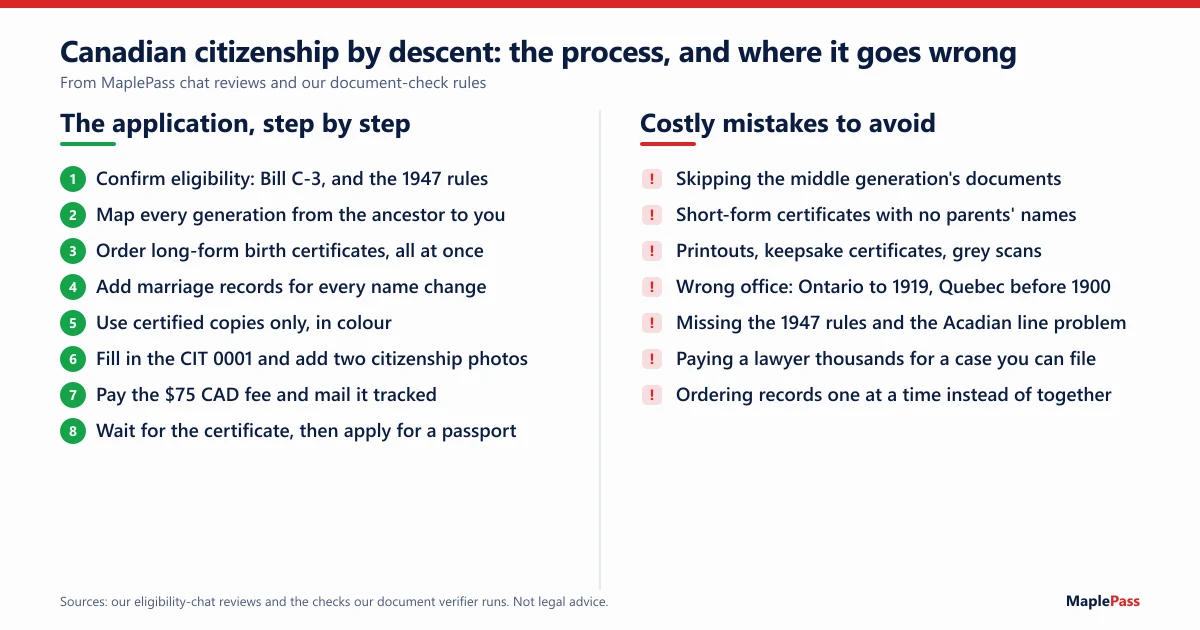
Most Canadian citizenship by descent applications fail slowly rather than quickly. Nobody tells you no on day one. A certificate arrives without the detail IRCC needs, a package goes back for a missing record, a line turns out to have lost its citizenship in 1952, and each round costs another two to eight weeks and another fee. This list comes from our reviews of real eligibility chats and the rules behind the automated check we run on documents uploaded to MaplePass. Here are seven mistakes that are easy to make and expensive to fix, with what to do instead. You do not need our tool, or anyone's, to avoid them. If you want the whole process first, start with the step-by-step application guide.
1. Skipping the middle generation
The ancestor is the exciting part: a grandmother born in Hamilton, a great-grandfather from Cape Breton. The chain is the boring part, and it is where applications stall. IRCC needs a birth certificate for every person between the Canadian ancestor and you, and the marriage certificate that explains each change of surname along the way. If your grandmother is the Canadian, that means her birth certificate, your parent's birth certificate naming her as a parent, and your own.
What it costs: a request for additional documents months after you mailed the package, then the wait for the certificate you should have ordered at the start.
Do this instead: write the chain down before you order anything, one line per person, and tick off a birth record and, where names changed, a marriage record for each. The CIT 0014 document checklist is the list IRCC itself works from.
2. Ordering the short-form certificate
Provinces issue two kinds of birth certificate. The wallet-sized short form shows the person's name, date and place of birth. The long form, called a certified copy of the birth registration in most provinces, also names the parents. Only the long form proves the link to the next generation. The short form is easy to order by accident, because both versions are simply called a birth certificate.
What it costs: a second order at $25 to $75 and another four to eight weeks, for every person you got wrong.
Do this instead: when ordering, look for the words "long form", "certified copy of registration" or "with parental information". If the form does not ask for the parents' names anywhere, it is the wrong one. Province by province details are in which birth certificate the CIT 0001 needs.
3. Sending copies IRCC will not accept
Our document check is built to flag the copies IRCC does not accept: a printout from FamilySearch or Ancestry, a decorative hospital certificate with footprints on it, a photocopy stamped "informational only" or "not a certified copy", and black-and-white scans of colour documents. None of these is a vital record in IRCC's eyes. Genealogy sites are wonderful for finding where a record lives, but the record itself has to come from the registry or archive that holds it. We explain the difference in why Ancestry and FamilySearch records are not proof. The one exception is a pre-registration ancestor, where a certified church record is the vital record.
What it costs: a returned package or a request for documents, and the time your file already spent in the queue. Our guide to why IRCC returns citizenship applications covers what happens next.
Do this instead: order certified copies from the provincial vital statistics office or the provincial archive, and send clear colour copies. Keep the originals.
4. Ordering from the wrong office
This one is not obvious, and for older lines it can cost months. The Archives of Ontario holds birth registrations from 1869 to 1919, and later births come from ServiceOntario (Ontario birth records before 1920 walks through it). Quebec civil records only begin in 1900 for the Directeur de l'état civil; anything earlier is a parish register, held in the civil copies at BAnQ, as covered in the Quebec baptismal records guide. Nova Scotia, British Columbia and New Brunswick move historical births to their provincial archives after a set number of years, and the archives have free public indexes that tell you the exact date and registration number before you order.
What it costs: a rejected order, weeks waiting for a letter saying "no record found", and sometimes a second fee at the right office.
Do this instead: check the ancestor's birth year against the province's rule before you order. For a Quebec ancestor born before 1900, start with the parish and the Drouin or BAnQ indexes, not the government office; for later births, order the Quebec certificate the CIT 0001 needs.
5. Missing the 1947 rules
Canadian citizenship did not exist as a legal status until January 1, 1947. That date decides more cases than any other fact. An ancestor who left Canada long before 1947 may have had no citizenship to pass on; the pre-1947 British subjects guide covers that case. A Canadian who became an American citizen between 1947 and 1977 lost Canadian citizenship on the day of naturalization, and whether it was later restored depends on when their child was born: see lost Canadian citizenship, 1947 to 1977 and, for the women it hit hardest, grandmothers who lost citizenship by marriage. Acadian and Cajun lines are the hardest case of all: the ancestor left what is now Canada in the 1700s, two centuries before citizenship existed, and whether such a chain carries status today turns on facts a form cannot settle (Acadian ancestry and Canadian citizenship lays out the arguments). In our October chat review roughly one in ten conversations started from exactly that family story, and those are the chains we send to a lawyer before anyone pays a fee.
What it costs: the $75 fee, the certificates, and a refusal after a wait that is close to three years at current processing times.
Do this instead: before spending anything, establish where each person in the chain lived on January 1, 1947 and whether anyone naturalized abroad before 1977. US naturalization records answer the second question. If the answer is unclear, that is the one case where paying a lawyer for an hour makes sense.
6. Paying a consultant for a case you can file yourself
A lawyer typically charges $1,500 to $5,000 for a proof-of-citizenship application, and a registered consultant $500 to $1,500. For a clean chain, that buys you a form you could complete in an evening. The CIT 0001 is designed to be filled in by the applicant, the fee is $75, and representation does not change your eligibility. The reverse mistake is as common: people assume they are not eligible because of the old first-generation limit, which Bill C-3 removed for everyone born before December 15, 2025, and never apply at all. The grandparent rule and born before 2009 guides sort out the two most common misreadings.
What it costs: thousands of dollars, or a citizenship you were entitled to and never claimed.
Do this instead: spend the money on the records, not the paperwork. Reserve professional help for a genuinely unclear 1947 question, an adoption, or a line through someone who renounced; when a lawyer is actually worth it lists those cases.
7. Ordering records one at a time
A simple chain can still take far too long when someone orders the ancestor's certificate, waits six weeks, reads it, then orders the next one. Every provincial office works in parallel; your application does not have to run in series, and the current CIT 0001 processing time is long enough without adding your own delays in front of it.
What it costs: months, for no reason.
Do this instead: on the day you map the chain, order every certificate at once, from every office involved, and only then start on the form. When the records are in, the CIT 0001 instruction guide takes the form section by section.
The short version
Map the whole chain. Order long-form, certified copies from the right office, all at once. Check the 1947 rules before you pay the fee. Keep colour copies of everything, use tracked mail, and expect to wait.
Frequently Asked Questions
Can a mistake in the application make me lose eligibility?
No. An incomplete package is returned or followed by a request for more documents; it does not affect whether you qualify. The cost is time and fees, not the citizenship itself.
Does IRCC accept records from FamilySearch or Ancestry?
No. Those sites are indexes and images of records held elsewhere. Use them to find the registry, parish or archive, then order a certified copy from that holder.
How do I know if an Ontario birth is at the Archives of Ontario?
The Archives of Ontario holds birth registrations from 1869 to 1919, and that range moves forward from time to time, so check its page first. Later births come from ServiceOntario as a certified copy of the birth registration.
My grandfather became a US citizen in the 1950s. Is the line broken?
Possibly. Canadians who naturalized abroad between 1947 and 1977 lost citizenship at that moment. Later legislation restored citizenship to many of them, but whether a child born after the naturalization inherited it depends on the dates. This is the question worth checking carefully before you apply.
Do I need a lawyer?
For a chain with clear records and no 1947 problem, no. The form is written for applicants, and MaplePass exists because the paperwork is the easy part once the records are right. If the 1947 facts are unclear, a one-hour consultation is money well spent.
If you want a second pair of eyes on your chain, the free MaplePass eligibility chat checks the 1947 rules against your family's dates and tells you which office holds each record. The $99 package then fills in the CIT 0001 from your uploads and checks every document before you mail it. The steps above, and the full application guide, work just as well without it.